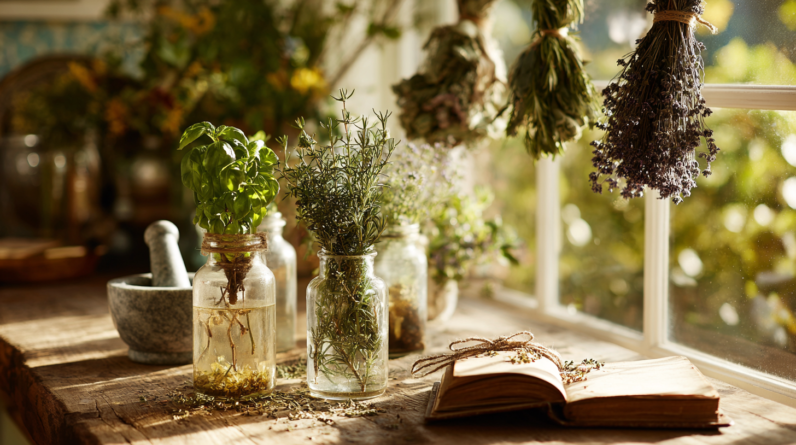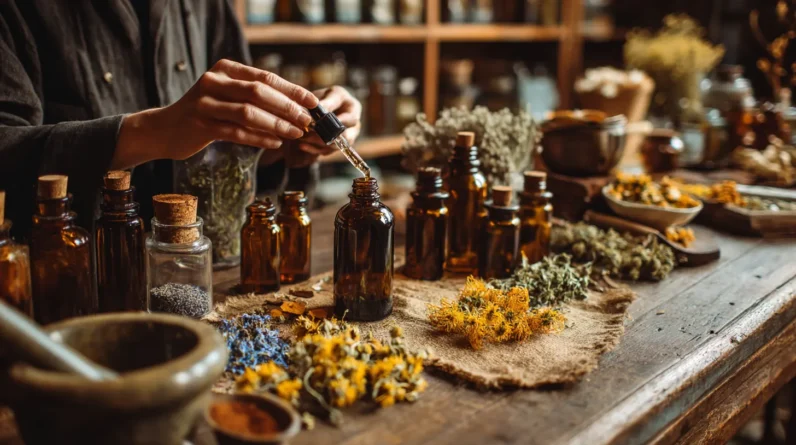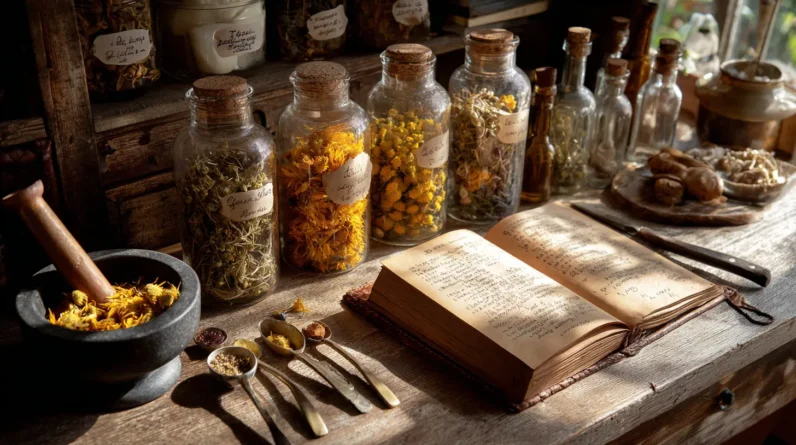
We can eliminate herbal medicine guesswork by sourcing from reputable suppliers offering third-party testing and certificates of analysis. You’ll want to master botanical identification using Latin nomenclature and document your preparations and responses to build a personal evidence base. Dosing safely requires age-appropriate calculations—children need one-quarter to one-half adult doses, while seniors benefit from lower amounts due to kidney function changes. Disclosing herbal use to your healthcare provider prevents dangerous drug interactions. Understanding when herbs support your family’s wellness versus when professional intervention’s needed keeps everyone safer.
Building Your Evidence-Based Home Herbal Medicine Cabinet
Foundation matters. We’re building a cabinet grounded in research and reliability, not trends. Start with verified herbal sourcing from reputable suppliers who provide third-party testing and certificates of analysis. This step eliminates contamination risks and guarantees potency.
Next, master botanical identification. You’ll need to recognize what you’re using—common names mislead, but Latin nomenclature doesn’t. Invest in a quality field guide or reference text specific to your region.
We recommend beginning with five cornerstone herbs: ginger for inflammation, chamomile for digestion, elderberry for immune support, peppermint for respiratory comfort, and turmeric for antioxidant protection. Each has substantial clinical evidence supporting traditional applications.
Document everything. Keep detailed records of preparations, sourcing information, and family responses. This becomes your personal evidence base, refined through experience and grounded in science.
Common Family Ailments and Herbs That Actually Work
Now that you’ve stocked your cabinet with verified herbs and established solid documentation practices, you’re ready to put them to work. We’re moving beyond herbalEscapes into practical familyWellness application.
Ginger addresses nausea and digestive upset effectively—documented studies support its efficacy. Elderberry reduces cold duration when taken early; evidence demonstrates measurable benefits. Echinacea strengthens immune response, particularly useful during seasonal challenges. Chamomile promotes sleep quality through well-researched mechanisms.
For minor wounds, calendula accelerates healing. Peppermint resolves headaches and supports digestion simultaneously. Turmeric’s curcumin provides anti-inflammatory support for joint discomfort.
Match specific herbs to identified ailments using your documentation system. Track responses carefully. This evidence-based approach transforms your cabinet from theoretical to genuinely protective—your family’s wellness depends on informed, purposeful application rather than assumption.
Dosing by Age: Safe Herbal Remedies for Children, Adults, and Seniors
Proper dosing is where herbal medicine shifts from beneficial to potentially harmful—and age dramatically shifts what constitutes “proper.” Children’s developing systems, adults’ established metabolisms, and seniors’ altered absorption rates require fundamentally different approaches to the same herb. We’ve learned that pediatric herbalism demands reduced concentrations—typically one-quarter to one-half adult doses for children under twelve. Adults operate at full therapeutic ranges, while seniors often benefit from lower doses due to compromised kidney function and medication interactions.
Herbal dosing precision prevents adverse reactions:
- Children require weight-based calculations, not age assumptions
- Adults tolerate standardized extract protocols effectively
- Seniors need liver and kidney function considerations
- Pregnancy and lactation demand specialized pediatric herbalism adjustments
We recommend consulting practitioner-grade references before administering herbs to vulnerable populations. This approach guarantees safety without sacrificing efficacy.
Understanding Quality, Safety, and Herb-Drug Interactions
Because we’ve established proper dosing protocols doesn’t guarantee safety, we must now examine the quality of the herbs themselves and how they interact with conventional medications. Herbal regulation varies substantially by region, making botanical identification critical for ensuring product authenticity. We recommend purchasing from suppliers providing third-party testing and certificates of analysis.
Herb-drug interactions can be substantial. St. John’s Wort reduces antidepressant efficacy, while ginkgo potentiates blood thinners. Grapefruit juice interferes with numerous medications through cytochrome P450 enzyme inhibition—the same mechanism many herbs employ.
We advise consulting pharmacists before combining herbals with prescriptions. Document all supplements you’re taking with your healthcare provider. This transparency enables informed clinical decisions and prevents potentially dangerous interactions that could compromise your treatment outcomes.
Integrating Herbal Medicine With Conventional Medical Care
Having documented your herbal use and identified potential interactions, we can now establish a collaborative framework with your healthcare team. Medical collaboration transforms herbal medicine from isolated practice into integrated treatment. We’re advancing beyond guesswork by leveraging herbal research and physician expertise simultaneously.
- Disclose thoroughly: Share your complete herbal protocol, dosages, and timing with your doctor
- Request evidence review: Ask physicians to evaluate current herbal research supporting your choices
- Coordinate timing: Separate herbal and pharmaceutical administration when advisable
- Monitor systematically: Track outcomes through both conventional and herbal interventions
Your practitioners need transparency about everything you’re taking. This partnership approach guarantees we’re optimizing your family’s health through informed decision-making rather than parallel, disconnected systems. Effective integration requires honest dialogue and mutual respect for evidence-based protocols, providing a thorough understanding of your health regimen.
Red Flags: When Herbs Aren’t Enough and Professional Care Is Needed
While herbal medicine offers genuine therapeutic value, we must recognize its limitations and know when to escalate to conventional medical care. We can’t treat medical emergencies with botanicals—chest pain, severe bleeding, and acute poisoning demand immediate professional intervention. Herbal limitations become apparent with serious infections, fractures, and conditions requiring diagnostic imaging.
| Red Flag | Response | Timeline |
|---|---|---|
| Severe chest pain | Call emergency services | Immediate |
| Persistent high fever | Seek physician evaluation | Within hours |
| Suspected fracture | Obtain imaging studies | Within 24 hours |
| Worsening symptoms | Consult healthcare provider | Before next dose |
We develop mastery by understanding when herbs complement care versus when they’d delay critical treatment. Professional collaboration guarantees we’re protecting our families through informed decision-making rather than dogmatic adherence to either approach.
Conclusion
We’ve built our herbal toolkit piece by piece—just as evidence and safety align perfectly with practical dosing. You’ll find that quality herbs, herb-drug awareness, and conventional medicine don’t conflict; they coincide, creating a thorough family strategy. We’ve covered everything from children’s remedies to red flags signaling when professional intervention’s necessary. You’re now equipped to navigate herbal medicine confidently, knowing exactly when to reach for these time-tested remedies and when to seek additional medical guidance.