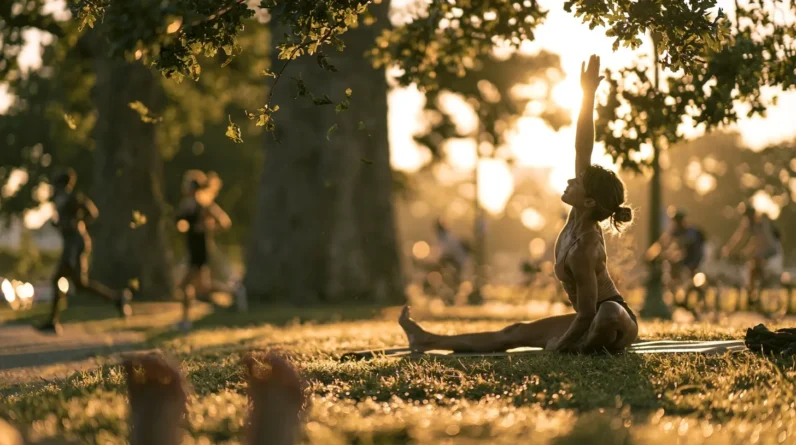
Healing exercises that begin with control work faster than intensity because they recruit the right muscle fibers, restore neuromuscular patterns, and build functional tissue without compensation. Controlled movement isn’t passive — it’s the mechanism behind real recovery. We’re talking tempo squats, dead bugs, eccentric loading, and intentional breathing that retrains your nervous system from the ground up. Master the slow work first, and everything that follows becomes stronger, safer, and more lasting.
Why Controlled Movement Heals Faster Than Intensity
When it comes to healing, slower and more deliberate movement consistently outperforms high-intensity effort. Here’s why: controlled movement allows us to recruit the correct muscle fibers without compensating, reinforcing proper neuromuscular patterns from the start. Intensity, by contrast, masks weakness. It floods the system with momentum, letting stronger muscles override the ones we actually need to rehabilitate.
We also reduce re-injury risk considerably when we move with intention. Tissues repair along the lines of stress we apply — meaning controlled, aligned movement builds stronger, more functional scar tissue than chaotic loading does.
Think of it as precision over volume. We’re not training less; we’re training smarter. Mastery begins with the capacity to slow down, notice what’s happening, and correct it before the next repetition.
The Role of the Nervous System in Healing Exercise
Controlled movement doesn’t just protect healing tissue — it actively retrains the nervous system, which is where recovery truly begins. After injury, the nervous system defaults to protective compensation patterns: altered motor recruitment, inhibited muscle activation, and movement avoidance. Left unaddressed, these patterns become permanent, not the injury itself.
Deliberate, controlled movement sends precise proprioceptive signals that restore neuromuscular communication. We’re fundamentally reprogramming movement maps in the motor cortex, rebuilding the neural pathways that efficient, pain-free movement depends on.
This is why slow, intentional repetitions outperform aggressive loading during early recovery. We’re not just conditioning tissue — we’re re-educating the nervous system’s interpretation of movement as safe. Master that neurological foundation first, and strength, speed, and capacity follow naturally.
Best Controlled Movements to Rebuild Strength Safely
Rebuilding strength safely starts with movements that prioritize control over load — and a few fundamentals consistently deliver results across injury types.
We recommend beginning with tempo squats, where the descent lasts three to five seconds, forcing neuromuscular engagement without excessive load. Dead bugs train deep core stability while keeping the spine neutral — essential before any heavy pulling or pressing. Eccentric single-leg lowering rebuilds tendon resilience gradually, addressing the connective tissue often overlooked in standard rehab. Pallof press variations develop anti-rotational core strength, protecting the spine under functional demand.
What these movements share is intentionality. Each rep demands focus, breath control, and deliberate positioning. We’re not chasing fatigue — we’re building the precise motor patterns that support heavier, more complex loading down the road.
How to Progress Without Losing Control or Causing Setbacks
Progressing safely means knowing when the body is ready — not just when the calendar says so. We advance only when we’ve mastered the current level — clean form, zero compensations, consistent execution. If we rush that threshold, we don’t build strength; we build dysfunction.
The rule is simple: add one variable at a time. Increase load, range, or reps — never all three simultaneously. When something feels off, that’s data, not weakness. We back down, reassess, and move forward smarter.
Setbacks usually trace back to skipping steps we thought we didn’t need. Control isn’t just the starting point — it’s the standard we hold at every stage. Progress earned through discipline lasts. Progress chased through impatience costs us more time than we saved.
Daily Habits That Support Controlled Movement and Recovery
Recovery doesn’t happen only in the gym — it’s built into everything we do across the day. Sleep, hydration, and nutrition directly influence tissue repair and neuromuscular function. Without quality sleep, our coordination and motor control suffer, making controlled movement harder to execute and easier to rush.
We also need to manage how we sit, stand, and carry ourselves between sessions. Poor posture and careless shifts accumulate stress that undermines the precise work we’re doing in training. Treat every movement — reaching for a glass, rising from a chair — as practice.
Intentional breathing throughout the day calms the nervous system and reinforces the diaphragmatic control we train. Build these habits consistently, and recovery stops being passive. It becomes an active, continuous process we own completely.
Frequently Asked Questions
Can Controlled Movement Exercises Be Safely Performed During Pregnancy?
Yes, we can safely perform controlled movement exercises during pregnancy, but we must consult our healthcare provider first. They’ll help us tailor movements to our trimester, ensuring we protect both mother and baby.
How Does Age Affect the Body’s Response to Controlled Healing Movements?
Age transforms everything about how we recover—younger bodies bounce back lightning-fast, while we older practitioners must embrace slower adaptation, prioritizing precise neuromuscular control, progressive loading, and extended recovery windows to master controlled healing movements effectively.
Are There Specific Breathing Techniques That Enhance Controlled Movement Recovery?
Yes, we’ll find that diaphragmatic breathing synchronizes with controlled movements, amplifying neuromuscular coordination. We can use box breathing to regulate cortisol, while exhaling during exertion optimizes intra-abdominal pressure, accelerating tissue repair and proprioceptive refinement.
Can Controlled Movements Help Recover From Neurological Conditions Like Stroke?
Like rewiring a circuit board, controlled movements absolutely help stroke recovery. We’ve seen neuroplasticity studies confirm that deliberate, repetitive motion rebuilds neural pathways, restoring function you thought was permanently lost.
What Role Does Nutrition Play in Supporting Controlled Movement Rehabilitation?
Nutrition fuels our neural repair and muscle function, so we can’t overlook it in rehabilitation. We’ll want to prioritize omega-3s, antioxidants, and adequate protein to optimize neuroplasticity and support the precise motor control we’re rebuilding.
Conclusion
We’ve walked the same road as Aesop’s tortoise — steady, deliberate, and ultimately victorious. Healing doesn’t reward the reckless sprint; it rewards the patient, controlled step. When we honor our body’s signals and move with intention, we’re not just recovering — we’re rebuilding smarter. Let’s commit to control as our foundation, because sustainable strength was never built in a day, but it’s absolutely built every single day.